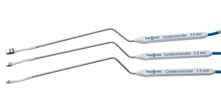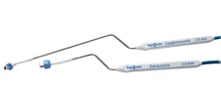
Extracranial Charbel Micro-Flowprobes
Learn More



Intraoperative measurements take the guesswork out of blood flow assessment during aneurysm clipping, extracranial to intracranial (EC-IC) bypass surgeries, arteriovenous malformations (AVMs), dural fistula obliteration, and tumor resection surgeries.
During aneurysm clipping surgery, flow measurements help surgeons achieve optimal clip placement to obliterate the aneurysm without compromising flow in parent vessels and distal branches. Measurements either confirm the surgeon’s clinical assessment of flow preservation or expose the need for immediate correction of flow deficits. During temporary clippings, flow measurements offer an assessment of collateral flow reserve and predict the safety of the temporary clipping.
During EC-IC bypass surgery to preserve or augment distal cerebral perfusion, flow measurements aid the surgeon in choosing the most appropriate bypass and predicting its future patency. Intraoperative blood flow measurements thus provide invaluable quantitative flow information for a surgeon to:

It is the real-time, quantitative measurement of blood flow in a vessel obtained intraoperatively while the vessel is in its native state. A perivascular probe placed around the vessel gives the surgeon an objective flow value to consider alongside clinical assessment.
It helps the surgeon place the clip without compromising flow in the parent vessel or distal branches. The measurement either indicates a flow deficit that may need correction or confirms the surgeon’s judgment.
Yes. During temporary clipping, measurements assess collateral flow reserve and inform the surgeon's placement of the temporary clipping.
Bypass surgery aims to preserve or augment distal cerebral perfusion. Flow measurements help the surgeon choose the most appropriate bypass and assess its function before closure.
Surgeons can identify inadvertent vessel compromise, confirm preserved flow, and quantify flow augmentation.
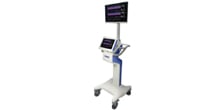
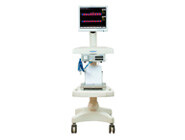
Transonic offers the Extracranial Charbel Flowprobe, the Intracranial Charbel Flowprobe, FlowXL, and AureFlo. Each has its own product page with details.
Transit-time ultrasound measures volume flow, while pen-tip Doppler measures flow velocity. Learn more in Transonic's technical notes comparing cerebrovascular measurement modalities and transit-time ultrasound and pen-tip Doppler.
Resources include a webinar on intraoperative flow measurement during neurosurgery and a video interview with cerebrovascular neurosurgeon Dr. Sophia Shakur. Transonic also offers the Cerebrovascular Volume Flowprobe Handbook, a literature pack, a publication brief and a reference list, along with a page on flow-based surgical techniques.